Tuesday, 13 March 2012

Videoblog 1: 'World Cup '90'

Chris O brings you the first Football Attic Videoblog, the subject of which is the 20-part football folder, World Cup '90 by Orbis Publishing.


Saturday, 10 March 2012

Rich J's Favourite 5... Subbuteo Items

Following Chris' excellent trip down memory lane, I ventured into my garage today to drag out the box that contains most of my childhood Subbuteo stuff. As you can see below, it wasn't exactly being looked after.

 Thankfully, the contents seemed to have survived.

 
Memorabilia secured, it now passes to me to list my favourite subbuteo items. I have to say that these are not necessarily my top 5 - I've left a few things out in order to look at some of the minutiae that made my Subbuteo days all the better. This is why my favourtite goals (Mundial World Cup style - huge box type goals with bright yellow nets) do not get an outing here... they can wait.

1. Player Numbers (61206)

The smallest details can make or break an experience and for me, realism is very important. Naturally, with Subbuteo, there's already quite a large amount of 'suspension of disbelief' going on. Your team may well be resplendent in finely detailed kit, albeit more often than not without sponsor, but one simply can't ignore the fact that you are in effect fielding a team comprised of ten clones and one other who looks like the answer to the question 'What happens if you mix carbonite with a Mexican wave?' Added to this, your clone army are all flying around on something resembling flying saucers, so as I say, we're already having to use a lot of imagination. With that in mind, anything that adds that extra touch of realism is surely a good thing? That's where player numbers come in.

Finally!
As these were a relatively cheap accessory (relative to other Subbuteo products that is, not to my pocket money alas), they were a no brainer. There were, however, two things you needed to get the most out of these... an almost infinite amount of patience and fingers the size of a baby vole. Separating the small numbers from the backing was the first challenge. Often, the machine which made the cuts in the plastic sheet had gone a bit too far and the backing came with it. Then there was the swear-inducing moment when you realised the near invisible circle was no longer attached to the tip of your finger, but instead nestling among the fibres of the carpet/stuck to your clothes/floating merrily away on an errant breeze. Eventually, player and number came together. Then began a game of cat and mouse as you chased the bloody thing round the clone's back, desperately trying to get it to place in the middle and not at some obscure angle. Finally it was done. Perfect alignment, perfect angle. Just need to press it home to fix it securely... which it did...to your bloody thumb!!!

Did I say these were one of my favourite things? Well they are, for despite all the hassle of actually affixing them, once attached they did look the business. Just look at them. No longer ten clones, these players now had a role to play. No more would the centre forward of matches past be expected to play sweeper. Of course, the goalie already knew his place. He needed no number to affirm his role. He'd probably have killed for some muscle rub, though.

2. Scoreboard (61158)

One of the many joys of finding stuff from many years ago is the little things you'd fortgotten. Seemingly unimportant events you had no need to remember at the time, but years later providing an insight into a distant time. So it was as I prepared to open the box to my scoreboard, I couldn't wait to see which team names were in place. Who had taken part in the last ever Subbuteo match of my childhood? I slid the black plastic out of the box and there it was... nothing! I'd taken the team names out. Even the score was set at 0-0. Ah well.

Even in 1988, it was still all about Italy v West Germany

The scoreboard itself was a slab of black plastic with rotary dials to set the score (so long as no-one scored more than nine) and three slots in which to insert the competing team names as well as the event taking place. Several sheets of black card were supplied with reams of team names, written in a pseudo-light bulb font. The options available seemed to cover pretty much every European team going and almost all known competitions, as well as more specific ones such as 'Quarter Final' and 'Group Two'. While I may not have been able to see who I'd last played with, I could at least see who had taken part in previous outings by those team names I had cut out. Unsurprisingly these were just the teams I owned along with 'World Cup 86'.

Come on you Wels!
Oddly enough, despite being able to take part in such exotic competitions as the Subbuteo League, where you could witness the top of the table clash between 'Ards' and 'Simmering', there doesn't seem to have been an option to play a 'Friendly' as I'd taken one of the blank strips and pencilled it in myself. An odd exclusion I think you'll agree. Maybe in Subbuteo world it was all or nothing. No time for pleasantries and all that. Could explain why the 'Players Handshake' accessory pack (C1923) never sold all that well. It may also have been because it never existed, but that's not what's important.

Even the great Winterthur were there...

Overall, with its plethora of options and imposing nature, dominating the touchline as it did (also meaning it got in the way a lot), the scoreboard was a very special addition to the Subbuteo experience.

3. Coventry City 86/87 Home (Team No. 652)

An FA Cup Winner
I never actually owned that many Subbuteo teams - about ten in total. 20% of these were naturally my home team. The two versions I had of Coventry were the FA Cup winning kit of 86/87 and the following year's Hummel one, my favourite CCFC kit of all time. It would therefore be safe to assume that my favourite is the latter of the two then? Well, no. While I loved the kit itself, both in actual and Subbuteo form, my favourite is the 86/87 version... and not because it's the FA Cup winning one (did I mention we won the FA Cup? - Still the last Midlands club to do so).

In Pescara, the phrase 'Coventry who?' is often heard
Why? Because it meant that for the first time, my Subbuteo matches could feature my home side in the kit they actually played in, rather than the one from last season - Subbuteo were not exactly quick in updating their teams at that time so if I wanted Coventry to play, they'd have to wear the Umbro, Glazepta sponsored outfit from 85/86 and that was just not going to happen. So when the new version appeared, I snapped it up for the princely sum of £2.35 from Barnby's. That very afternoon, Coventry took to the field and ground out a 1-0 victory over Brazil. Due to Subbuteo's clever way of using similar looking kits for several different teams, both Colchester and Pescara (?) have also tried to claim this result as their own, but for me, it was a proud moment... just a shame the player who got that crucial winning goal ended up in defence for their next game.

4. Adidas Tango balls - Orange (61209)

The Adidas Tango... is there a more iconic football design in the history of the game? No, is the simple answer. Sure, others may claim the classic black and white 32-panel ball (Telstar) got there first and the orange ball from the 66 World Cup final might cause more dewey eyes (maybe not in Scotland perhaps), but it matters not. The Adidas Tango IS simply the best ball design ever conceived. It goes without saying then that the Subbuteo version is clearly the best in the table top world too. My personal favourite however, is the orange variant. While the classic white version may be more well known, the orange one in play usually meant only one thing... SNOW! You see, back in the pre-premiership days, before under soil heating that actually worked, the arrival of snow was not greeted by a cancellation and rearranged fixture. Lord no, all that was required was a few volunteers to clear the pitch markings and a bright orange ball. The match may have looked as though it was being shown in negative, but we just got on with it.

All very well for the real world, but snow never really fell on the hallowed green baize, unless your older brother decided to accessorise the pitch with some shaving foam. As we've already seen however, pretending is a big part of Subbuteo so if I say it's a snow covered pitch, then it's a snow covered pitch and we need an orange ball!

Later, a luminous yellow/green Tango was released and it also graced many a match, but deep down, it just seemed a gimic too far.

So there you have it. The Adidas Tango... iconic, versatile and a metaphor for the excess of the late 80s.

5. Astropitch (61178)

It is with a degree of smugness that I write that I owned the Astropitch as it was about three times the price of the standard pitch. Contrasting nicely with the view on 'artificial' pitches in real football, the Astropitch is rightly considered the king of surfaces on which to 'flick to kick'. Before I owned it, I had assumed it was a surface similar to that used in the cricket game Test Match, which flattened out well as it was made from polyester, but on purchase (in fact, on first picking it up, stored as it was, rolled up in in its poster tube) I realised this was not the case. It was a heavy thing and on unfurling, flattened out perfectly every single time. Not ony that, but the flock covering and heavy vinyl backing gave an almost damping effect which meant the ball didn't skim around as much, but instead, moved in a graceful, flowing and controlled manner.

When I first bought it, I wondered if it would prove to be an extravagance too far at £14.95, but after the first few flicks, it was obvious this was the future! From that point, my regular pitch, complete with its creases that just never fully went away, never saw action again.

Thursday, 8 March 2012

Chris O's Favourite 5... Subbuteo items

Peter Adolph was a clever man. Not only did he invent a brilliantly immersive game in Subbuteo, but he also catered for the comforting need to collect that is found so often in the young.

I can’t remember exactly when I started playing Subbuteo. I was probably 9 or 10 years old, and as far as I can tell, it all started when I received a Club Edition set as a Christmas or birthday present.

It was a good place to start. The basic kit contained two teams, two balls, a cloth pitch, two goals and some corner flags. Having made extensive use of that, I was ready to indulge my interest by buying more teams and more accessories, usually from my local toy shop – Worrickers in Barking.

It was the sheer variety of stuff available that made the game the joy that it was. Over many years, I collected all manner of wonderful miscellanea, so I thought it was high time I told the world what my five favourite bits of Subbuteo ephemera were.

1. FIFA Balls (C183)

Unlike m’colleague, a younger chap and only too happy to remind me of the fact, I played Subbuteo in an era before Adidas Tango balls became commonplace. This frustrates me because those Subbuteo Tango balls really were as much a thing of beauty as the full size ones used in the 1978 and 1982 World Cups.

Anyway, it wasn’t all doom and gloom for me in my flick-to-kick youth because those nice people at Subbuteo brought out an alternative – FIFA Balls. Not the name of a Sepp Blatter-penned in-house newsletter, these were white footballs that had a pleasing ‘circular’ arrangement of six coloured hexagons – one in red, one in blue and one in green.

To the best of my knowledge there never was any proper ball designed to look this way, but frankly I didn’t care. Compared to the standard white or orange balls that came with the old Subbuteo sets, these were as exciting, futuristic and modern as a kid could ask for in the early-1980’s. Sadly my favourite, the red one, saw its printed hexagons fade with wear fairly quickly, but no matter. This was a classic piece of kit and a much-valued one in my collection.

2. World Cup Goals (C130)

Having got your hands on a fine set of balls (ahem), what better than to flick them into a goalmouth to match?

At some point, I came to acquire a pair of World Cup Goals to replace the standard ones that were sold with my Club Edition, and no bad thing in my view. The originals had a rather restrictive bar across the back bottom edge of the net which meant if anyone flicked the ball high into the corner of your goal, your keeper couldn’t reach up sufficiently to stop it. Perhaps that was a deliberate ploy to encourage more goals to be scored. If it was, you wonder whether anyone thought to notify the aforementioned Mr Blatter.

The World Cup Goals had nice, rounded posts (rather than the square, angular ones from the Club Edition) and, if memory serves, coloured nets too. Most importantly, that wretched horizontal back bar had been removed. From here on in, it was total unfettered access to all four corners of the goal for our keepers, even if it was an unrealistic slant on the real world being simulated. Bliss.

3. Trainers Bench Set (C179)

Small, but perfectly formed, the clear plastic Trainers Bench provided that extra little touch of class to every game.

Four players in green tracksuits and their manager wearing an old-fashioned brown coat looked every inch the authentic article when placed pitchside. To be ruthlessly honest, one never saw players warming up in green tracksuits in real life and the stereotypical manager wearing a sheepskin coat was probably becoming more of a rarity when this item hit the shops, but somehow it worked.

Much like the Stadium Grandstand (see below) with all its disparate spectators, the addition of a Trainers Bench seemed to give the impression that the game you were playing really mattered. There were people watching in the crowd and there were substitutes ready to replace their injured teammates, should the occasion arise.

No-one need be deluded that this was just about two people flicking bits of plastic around. This was a proper match with proper detail, and the bench – even two benches if you were a connoisseur – helped to retain that air of authenticity. Quite how the modern-day equivalent – three rows of colour-coordinated Recaro seats – would look is anyone’s guess. Thank heavens, then, for simplicity of design.

4. Stadium Grandstand (C140)

I’m proud to say I once owned a Stadium Grandstand section, but it wasn’t something I’d bought with my own money. My budget didn’t run to that.

No, luckily for me, my family home was once visited by a distant, rarely seen aunt who struggled into our front room with two bulging carrier bags. “Here you go” she said. “These belonged to my son, but he doesn’t want them anymore. He’s far too old for them now.”

I emptied the bags and found, along with various teams and other items, an entire Stadium Grandstand. Yes it looked a little old fashioned with its white serifed text printed along the top edge and dowdy terracing coloured in a shade of Heavy Smokers Cough, but at a stroke it elevated my average Subbuteo playing experience to a whole new level.

It even had a few randomly placed spectators dotted hither and yon, glued permanently in position and painted accordingly. Now, my hastily arranged matches with invited school friends would be watched by a crowd in a stadium stand. Hardly Wembley, granted, but it was a crowd that added immeasurably to the make-believe world we played our Subbuteo in.

5. West Bromwich Albion team (away, 1983)

This always brings back special memories of my late father. I must have been about 11 or 12 years old when I once found myself struck down with tonsillitis. I was at home feeling poorly and not a little sorry for myself, my absence from school being a sole reason for any happiness on my part.

Things, however, were to take a turn for the better. My Dad, never a well-paid man in all his working life, was aware of my plight and had decided to go via a nearby toy shop on his way home from work. His motivation: to buy me a get well present to lift my spirits.

Having arrived home, Lambretta parked outside, he came in, took off his coat and handed me the present. “There you are” he said. “I don’t know if you’ve already got that one.” It was clearly a Subbuteo team, but one I wasn’t familiar with. The players were wearing yellow shirts with blue horizontal pinstripes, blue shorts and yellow socks. A quick check of the label on one end of the box confirmed it was The Baggies in their latest change strip.

To be honest, he couldn’t have picked a weirder team out of all those on sale, but I loved it for its modern pinstripes and the yellow and blue colour scheme. If nothing else, it could double up as Sweden, but regardless of all that, I loved it because he had thought of me feeling under the weather at home and had wanted to cheer me up. My Dad didn't really know anything about Subbuteo, yet despite this, his choice was somehow perfect.

For that reason, I'd like to dedicate this post to his memory with my thanks and love always.

Tuesday, 6 March 2012

The Football Attic - in your ears!

Ever wondered what your Football Attic co-founders sound like in real life?  We're guessing probably not, but if you are in any way curious, you now have the chance to hear us taking part in this week's Sound of Football podcast.

Chris is the regular presenter of the podcast and is joined every week by Terry Duffelen and Graham Sibley, however Graham's absence this week allowed Richard to take his place for a wonderful chat about football nostalgia.

The Sound of Football podcast is available to download via iTunes, Net Radio UK and Football Fairground.

Sunday, 4 March 2012

International Football Book No.13, 1971

I’m not sure how many people are aware of the International Football Book these days. It’s certainly a new title on me, though in my defence it doesn't stand out with the most distinctive of names. For many years it had a similarly unspectacular appearance to match, but then the IFB was first published in 1959 when printing techniques and marketing strategies were that bit more primitive.

Visual appeal (or a lack thereof)

The International Football Book was essentially an annual containing a comprehensive collection of articles by football figures and writers around the world. The edition I recently bought on eBay is the 13th, published in 1971. Beyond its orange front cover showing a colour picture from the 1970 World Cup, it’s black-and-white content all the way through to the back, but it's not just text. There are dozens of pictures decorating virtually every page and it breaks up the reading matter nicely. Curiously the photos don't often match up with the article they appear next to, so one can only assume the photos are included as an ongoing gallery of football action rather any kind of co-ordinated journalistic masterpiece.

Sponsorship

No matter. By 1971, the IFB was already ploughing a lonely furrow as a title that was thorough in its writing if not its imagery. This 13th edition begins with an article by Sir Matt Busby calling on the FA and Football League to work more closely together to avoid a split following growing friction between the two. Both parties had recently formed a joint committee to discuss key issues such as finance, player discipline and international matches (sound familiar?) and Busby felt the time was right for the Football League to have more say in the running of its competitions and clubs.

The former Old Trafford boss also talked about the recent growth in commercialism in the game at the time. "I was glad Manchester United were able to take part in the Watney Cup" said Busby. "Times change and I think it sensible that soccer should now be prepared to examine the ideas of people who are willing to put money into the game in return for having their names associated with some aspect of it." Quite what he'd have made of the Johnstone's Paint Trophy, one can only wonder.

The Turnip Mentality

One thing the International Football Book did with great efficiency was to get international football players of the day to write articles for them. OK, admittedly they were probably ghost written or translated casually into English, but the fact that they could call on many a true star was rather impressive.

Luigi Riva was one such star. Italy's top goalscorer of all time was the darling of his nation, but the paparazzi were fascinated to portray his life outside of football - sometimes too intrusively as he explained. "[Back in 1968] they were after a photo of me, preferably in a nightclub kissing a girl. Any girl - even just a little peck on the cheek would have been enough for them... Sometimes I think, even against double-marking, it's easier to score goals than it is to get a little privacy..."

Having assured us that most of his earnings went unspent and that his holidays usually involved spending time with his mother, Riva then gave a delightfully frank view of some of his fellow professionals, the like of which we need more of in these boring, media-sanitised times: "I've been really disappointed by the supposed sportsmanship of some other football countries" he said. "The Swedes, for example, are said to be amateurs, supposed to play for pleasure rather than money or success. But in my opinion the Swedes ruined their reputation in the [1970] World Cup in Mexico."

He went on: "The Swedes played much too slowly and their way of shooting is antique. Also they have no imagination, little skill and are much too slow..."  Try getting a quote like that out of Steven Gerrard.

Between the sticks

Elsewhere in the book, the roll call of stars kept on coming. There was George Best explaining that European competition was vital for Man United and that his recent hot-headed spell was all down to the sort of 'close marking' that Gigi Riva could associate with. Three articles focused on the life and career of some of Britain's top goalkeepers - Bob Wilson, Pat Jennings and Gordon Banks.

The latter pointed out that though he'd be 35 at the time of the next World Cup in 1974, he still intended to be considered as England's first choice 'keeper, despite the burgeoning new talent of Peter Shilton arriving on the scene. Sadly for Banks, a car crash in 1972 left him without the sight of his right eye and England failed to qualify for the 1974 World Cup anyway. Ironically, it was Peter Shilton's mistake in a crucial match against Poland that resulted in Alf Ramsey's men staying at home that year.

Brian Glanville's Top Twenty

The reassuring presence of Brian Glanville was here, too, as the World Soccer writer listed his score of top players in the world for 1971. As perhaps you'd expect from such a well-travelled, studious academic of the game, some of the players on Glanville's list were not as familiar as others. For every Alan Mullery or Rivelino there seemed to be an Atilio Ancheta (Uruguayan defender) yet Glanville's undeniable ability to spot an upcoming star was there for all to see.

Dutch midfielder Wim Van Hanegem was picked out for special mention on the strength of his performance for Feyenoord in the 1970 European Cup Final - several years before becoming a global star in the final of the 1974 World Cup Final for the Netherlands. Berti Vogts also ended up on the list as "one of the best all-round full backs in the world" despite still being in the early stages of his international career.

IFB Editorial

There was a definite shift in people's interest in football around the time of the 1970 World Cup. The IFB Editorial noted the way that in previous years, journalists were sent abroad to track England's progress in the four-yearly tournament, and once they were eliminated, the journalists packed up and returned home. Anyone wanting to hear about the remainder of the tournament had to more or less do without any reporting in the press whatsoever.

The 1970 World Cup changed all that. With the exciting exploits of the Brazil team played out before a global audience in full colour, plus an emerging new breed of fresh stars such as Beckenbauer, Boninsegna, Gerd Muller and the aforementioned Riva, the public wanted to see more and know more. "Even [after the Final] the colour films, full length movies made to be seen months later in cinemas the world over, prove that the World Cup has converted us all."

For journalists and fans to remain in Mexico even after England had been knocked out in the quarter finals there remained one barrier - that of the poor transport facilities in the Latin American country. The IFB Editorial bemoaned the impractical and expensive solutions available to newspaper writers covering various matches. Waiting lists for plane tickets, expensive taxis travelling from city to city, unreliable bus and train services... they all proved Mexico to be an "unsuitable choice" as World Cup host, especially when Switzerland, Sweden and England had hosted the same event without any such problems. Whether Ukraine will show we've moved on from such problems this summer remains to be seen.

The celebrity connection

Aside from a section at the back of the book listing the results and stats for every European national team from the past year, it just remains to close with an article by Peter Jones about the many celebrities who support their favourite clubs through thick and thin. If your time machine landed in 1971 and you were unaware who was entertaining the nation at the time, you'd need only pick up the International Football Book to find out.

There's Jimmy Tarbuck, pictured on the back end of his Aston Martin DB6 (obligatory 'COM1C' number plate in full view). Even back then the Scouse comedian was trotting out corny gags by the dozen: "Suddenly the floodlights failed and the game was abandoned... Obviously bad play stopped light!"

Star of Please Sir! John Alderton, was quite happy to turn down some well-paid work to follow the World Cup in Mexico, so we were told. Nearer to home, we learnt that Richard Attenborough was on the board of directors at Chelsea and Eric Morecambe was a director in his own right at Luton Town.

As for all-round entertainer Roy Castle, "he felt sick at having to wear contact lenses... sick, that is, until he found out that his hero, Nobby Stiles of Manchester United, also wore them when playing!" Castle was a Huddersfield Town fan and any quips you're thinking of connecting bad eyesight with the Yorkshire club are made purely for your own amusement.

Thursday, 1 March 2012

Heineken advert, 1978


...to say nothing of the parts most dentists wouldn't touch with a barge pole.

Wednesday, 22 February 2012

Panini: Football 78

Panini’s first foray into the world of annual UK sticker collections began with Football 78. Its bright red cover featuring action photos neatly sectioned into the hexagonal patches of a big football was a beacon for kids across the country to go out and fritter away what little pocket money they had at the time.

For many sticker collectors, this was where it all began - the start of a lifelong obsession. The Queen's Silver Jubilee had been and gone, and now it was time to celebrate something altogether different: the glorious sport of Football itself.

Page 2 and 3

Inside, we get an early sight of two elements that would become familiar in later years: a grid for filling in First Division results (some of which were already filled in for you up to October 15th 1977) and the trophy page with spaces for stickers of the FA Cup, League Championship Trophy and the two Scottish equivalents. Of those four stickers, only the FA Cup and Scottish Cup were in gold foil for reasons we’re still trying to fathom out.

First Division pages and stickers

The team pages came next – two for each club with spaces for seventeen stickers each. Strangely in this first domestic Panini album we see an odd reluctance to fit in an extra player on the first page to create a uniform layout. Note the odd row of three rather than four where the manager and goalkeeper images reside…

The double-page spread has a familiar look for those that remember Panini’s later efforts, but in this early period the preference was to show biographies of each player in a single block on the second page rather than individually below each player’s picture.

There was also the statistics block situated between the badge and team photo; a mini-feast of facts and information for the knowledge-hungry child wanting to know a club’s record attendance or the change colours of Wolverhampton Wanderers.

As for the stickers themselves, the ’78 design was that of a red window frame with English flag, team name and badge at the top and player name at the bottom. Team badges were of the hard gold foil variety while team pictures used a similar design to those used for the players.

What’s notable about the player photos in this early Panini vintage is that each team member wasn't necessarily  seen wearing the same shirts. In many cases you can pick out two or even three different shirt designs per team, something Panini made a point of correcting to a large extent later on.

Second Division

Subsequent Panini albums may have dared give you a glimpse of life in Divisions Three or even Four, but it's only the second tier of English football that was spotlighted here. Again there was another results chart to complete (half of it already having been done for you) before the minimal format of badge-statistics-team picture rolled out across six pages.

Here we get our first glimpse of the double foil badge – a regular-sized sticker split in two for twice the pleasure. Even though the Second Division badges were, in reality, only half the size of their First Division equivalents, there was something undeniably joyful about getting two on the one sticker.

As for the teams listed, there was an eclectic mix of the rising stars, the fallen wonders and the perennial water-treaders. Premier League stalwarts such as Bolton, Fulham and, yes, even Tottenham Hotspur sat cheek-by-jowl alongside teams like Bristol Rovers, Orient and the previous season's Division Three champions Mansfield Town.

Scottish Premier Division pages

If you think there's a two-tier structure in the SPL today, that was nothing compared to Panini's view of the Scottish Premier Divisiom in 1978. Aberdeen may have been first in alphabetical order, but there was a pecking order to observe. First came Celtic and Rangers, treated royally to the same double-page spread of their English counterparts. Everyone else followed and had to make do with only a single page, if you don't mind.

Hardly fair treatment, really, especially as that only left enough room for seven players to accompany the manager, club badge and team picture. Still, at least we got a fair selection of the pale, pasty-skinned and wild-haired talent making a name for itself north of the border, as well as the ubiquitous half-completed results grid.

Sadly no Scottish First Division pages were included in this collection – they were to come in later years – but at least the strange array of Scottish Premier Division club badges made up for it. Celtic's badge looks a good 15 years ahead of its time, Clydebank's looks like it's been extracted from the cover of the Communist Manifesto while St Mirren seem to have settled for something scribbled on the back of a fag packet by Alex Ferguson himself.

Curiosities

Aside from the ongoing 70's competition to see 'who looks more like Graeme Souness than Graeme Souness', there's much to please the idle browser of this album. Sir Alf Ramsey makes an appearance as Birmingham City manager (Panini politely leaving out the word 'Caretaker' for such an undoubted legend of the game), while Everton's team picture appears to have been taken on a 1:3 hill.

Phil Thompson's lovely head of hair can only, in our opinion, be put down to him visiting the same stylist as Wendy Craig, star of BBC TV's 'Butterflies' whereas the winner of the award for the 'Too-Frightening-For-Words Pose' undoubtedly goes to QPR's Stan Bowles. 'Most Overlooked Badge'? That must go to the one worn by many of West Bromwich Albion's players… anyone know anything about this?

As for the team trying hardest to look professional in its team picture, that must surely go to the aforementioned Clydebank who all appear to be wearing the biggest stitched-on numbers ever on their red tracksuit tops. A fine effort there, we're sure you'll agree.

Back cover

A never-more-70's hand-drawn vignette depicted as if zooming away from view in a vivid red-orange-yellow colour scheme. A bit like the opening titles to a Lew Grade British spy thriller series shot through the prism of an official FIFA World Cup film. Kind of.

Sunday, 12 February 2012

Interview: Gary Silke and Derek Hammond (Got, Not Got)

Gary Silke (left) and
Derek Hammond (right),
authors of Got, Not Got
Gary Silke and Derek Hammond are the authors of a recently published book called Got, Not Got, a title that has quickly become an epic tome for lovers of football nostalgia everywhere including ourselves. The book sold in great numbers over the Christmas period (rightly so in our opinion), so we decided to have a chat with Gary and Derek to find out more about Got, Not Got and their love for the bygone days of The Beautiful Game.

TFA: First of all, let’s begin by congratulating you both on the huge success of the book. It’s richly deserved... but how did the project begin?

DH: Thanks a lot! I'm not sure the success is exactly 'huge' but we've had a very promising first few months both in terms of growing sales and press and reader feedback.

We first punted a book to publishers about 7 years ago - centered all around 'Supersonic Soccer Stuff They Sold Us in the Seventies' - and we had a couple of very near misses. About three years ago something much more like GNG was again touted around by a different agent, with the same response. The feedback we were getting all suggested it would be impossible to sell football nostalgia to fans of more than one club.

TFA: And prior to the project starting, when did the two of you first meet?

GS: I'm surprised to say I can't really remember. I think Derek contributed something to my Leicester fanzine The FOX and it was quite funny. He was just a crazy kid looking for a break and hey... I took a chance on him.

TFA: Reading through the book, it’s plain to see how much time and effort has gone into compiling and writing all the entries. You must have reached a point where you realised there would be too many subjects to cram into one book... How frustrating was that for you?

DH: No problem! We realised early on that we couldn't possibly fit it all in, and started to think about GNG2... Now readers are sending us great ideas (fog! DIY ticker tape! Brut! proper drop balls!) and pictures on a weekly basis, and once again it's a case of having to decide what to fit in and what to leave out.

TFA: Despite all that, however, was there anything you forgot to write about or wished you’d included after the book went to press?

GS: I can't really think of anything we wish we'd included. Maybe rolled down socks in the manner of Rodney Marsh and the Argentina side of 1978?
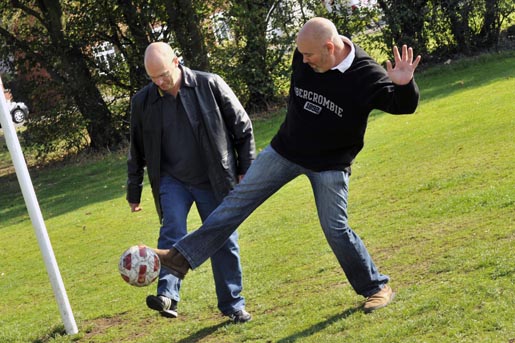
I was also desperately trying to get hold of a Striker diving goalkeeper to do a big close-up photo of but I kept getting pipped at the post on eBay. I SHALL get one for GNG2.

We started the book with the intention of doing 120 pages, but at a very early stage the publisher requested we make it 240. It soon became clear, even then, that a GNG2 would be required.

TFA: Which entries in Got, Not Got did you both particularly enjoy writing about?

DH: Swivel boots, Cov Girl of the Match, Shame, Smoke, Punk Rock Football. I'm easily pleased.  

TFA: We’re pleased and grateful to say you’ve also set up a Got, Not Got blog site to accompany the book. What are you hoping to achieve with the blog and what have been your favourite entries on the site since it began?

GS: Our publicity comes from a very grass roots level so it was important to get a blog going to help spread the word. With Facebook and Twitter added we have started to reach a wider audience. It is also a rallying point for like-minded people to come and discuss all our great old stuff. We want to encourage a wider level of participation for the next book. Everyone has a great story to tell and some old tat to illustrate it.

I like the stuff we are getting sent now because it is fresh to us and makes for a great blog entry.

TFA: Looking forward, you must still have lots of ideas buzzing around in your heads for future blog articles and entire projects, even. Is there anything you have in the pipeline you’re thinking about creating that you can tell us about?

DH: We're working on a humour book for publication later this year. Then there's GNG2 to look forward to, as we both accidentally let slip earlier!

TFA: OK, it’s ‘what if’ time now... If you had to create a football nostalgia Hall of Fame, what would be the first three things you’d put in it? (They can be real items or generic concepts, specific or general...)

GS: Subbuteo seems to hold a very special place in the heart of the nation and I see they are now relaunching it so it will no longer be a 'Not Got'.

Mud, sums up how different football was then. So that would be in. When was the last time you caught the smell of mud at a professional football game?

And just that feeling of quivering excitement you got when you were going to the match as a kid. I think only an FA Cup Final for Leicester City could re-ignite that feeling for me now. And even then I'd probably just end up getting annoyed by something modern.

TFA: And of all the items of football ephemera you actually own, what single things would you both nominate as your favourites, and why?

DH: For ironic bad-taste fun it has to be my Justin Fashanu rubber, cover star of GNG. I just got a very cool fake Action Man for GNG2, for 99p, complete with totally unnerving psychotic glare. No joking, he is genuinely scary.

From a more personal perspective it has to be my childhood box of football cards - which is why I was touched when James Brown at Sabotage Times reviewed the book and said it was just like finding his old football stickers.

TFA: Sticking with your own personal possessions, which items did you both once own that you now regret getting rid of?

GS: My Leicester City Admiral shirt was nicked from the PE changing rooms circa 1979. I'm just about over it, though I still intend to hunt down and execute the bastards who did it.

TFA: Is there anything either of you really wanted to own that you finally managed to purchase, and were you ultimately pleased or disappointed when you got it?

DH: I would give anything to see the original advert for swivel boots which so affected me back in around 1970. To see the actual boots, complete with the patent turn-on-a-sixpence rotating turntable of four studs under the ball of your foot... that would be close to a religious experience for me!

TFA: If you don’t mind us asking, have you ever spent a ridiculous amount of money on a single item of football nostalgia?

GS: I spent a ridiculous amount on two items, but probably not in the way you mean. This woman at a car boot sale had two matchworn 'Ind Coope' City shirts from the mid 80s. I asked her how much she wanted and she said: "10p.... each."

I paid and left. Does that make me as bad as the bastards who nicked my Admiral shirt? It does, doesn't it?

TFA: A lot of people are now becoming disenchanted with modern football for various different reasons. Do either of you fall into this category and what do you find so appealing about bygone football over and above the game as we know it today?

DH: We both fall deep into this category - I guess that much is pretty clear from the book - but of course we keep plodding to the football because we're hooked. The modern game lacks characters, atmosphere, a sense of fun and glorious abandonment, it's overpriced and over-defensive, players and coaches are scared to lose, and there aren't any floodlight pylons or greyhound tracks any more. Apart from that, it's great.

TFA: It’s been suggested to both of us that a better title for your book would have been ‘Got, Got, Need’ as an alternative refrain by sticker-collecting schoolchildren everywhere. Are you willing to admit you named your project in haste and apologise for your wrong-doing?!?!!

GS: In our playground it was always 'got, got, got, not got'. I think there are regional variations. The title works on two levels with everything in the book being something we had 'Got' and have now 'Not Got'. That's the only way it could work.

TFA: The FIFA World Cup in 2010 saw a sudden increase in the number of adults collecting Panini stickers, presumably as a way of reliving the joys of their youth. Do you consider it wrong in any way to collect stickers well beyond your childhood years or do you encourage such behaviour?!

DH: I haven't personally collected football cards since I was a kid, but Gary has. I'm a serious student of football culture and pop history, and my interest in vintage ephemera is for research purposes only. He's just an overgrown child. My collection, meanwhile, just happens to be expanding faster than his... but let me assure you it's for all the right reasons.

TFA: Speaking of Panini stickers, what’s the most stickers you ever swapped (or saw swapped) for just one other? (Rich J once witnessed about 300 swapped for a single Jim Smith which was needed to complete a Panini Football '87 collection...)

GS: I can't remember the figures but I had to hand over an absolute stack for Kevin Beattie to complete my 1973-74 FKS Sticker Album. And it was damaged so I had to do a repair job with a blue biro.

I learnt a lesson that day, keep your cards close to your chest and never advertise how much you need something.

TFA: Finally, what would you say is your personal cut off date, where ‘nostalgia’ ends and ‘modern day’ begins?

DH: 1992. Year Zero.

Gary and Derek, many thanks for your time and all the very best of luck with your future ventures. Keep up the good work with Got, Not Got!

Got, Not Got is published by Pitch Publishing and is available via Amazon.co.uk at the new low price of £11.99.

Wednesday, 8 February 2012

News of the World and Empire News Football Annual 1961-62

Behind the creased and crumbling cover of this 50-year-old pocket book lies not only 384 pages of facts, figures and statistics but a fading image of a football world few of us can fully appreciate.

Things were very different at the start of the 1960’s, including the title of our subject. The News of the World Football Annual (as it came to be known for more than 40 years) started out as the Athletic News Football Supplement and Club Directory in 1887. Little more than a pamphlet back then, it covered more and more content with every passing decade and merged with other similar publications, changing names as it did so. In late summer 1960, the 70th edition of the annual appeared, and for the first time, The News of the World saw its name on the front cover.

Stats, stats and more stats

The purpose of the book remained constant; to cram in enough anecdotal and factual information to sustain the most ardent football fan for an entire season. Beyond the hand-tinted picture of Sheffield Wednesday’s Ron Springett and Don Megson on the cover, there was more than enough to satisfy the enthusiastic youngster or the seasoned veteran, whatever their interests.

Though football had existed for around 100 years at the time of publication, the book showed the sport as only just entering a new era where foundations were being laid for the game we know today. The £20 maximum wage had only just been abolished (allowing players to earn anything up to £100 a week), the England team were preparing for only their fourth World Cup tournament and the great old teams of the 1950’s were slowly making way for the sides keen to make an impact in the 60’s and 70’s.

One-man teams

On this latter point, the NoTW Annual features a piece written by Tom Finney OBE, a legend for Preston and England who had retired in 1960. The Lancashire-born striker lamented his old club’s relegation at the end of the previous season and noted how other big teams of the era had only just avoided a similar fate. “Blackpool only just escaped it” said Finney. “How they will miss the inspiration of Stanley Matthews when the old maestro finally decides to call it a day. Without the skill and drive of Nat Lofthouse, Bolton Wanderers just steered clear of the danger zone. And how would Fulham have fared without the genius of Johnny Haynes?”

Tom Finney wondered whether the great teams of the day were too reliant on a single star-name player to get success. If they were, the removal of the £20-per-week wage limit in January 1961 was designed to keep more of them in the British game. Prior to the pioneering work of Jimmy Hill, chairman of the PFA, many Italian clubs were offering vastly better pay for any professional willing to up sticks for the continent. The Annual reported how Jimmy Greaves had joined Milan in June 1961 for guaranteed earnings of £40,000 over three years plus a £10,000 signing on fee. Aston Villa’s Gerry Hitchens went to Inter in the same month for £25,000 over three years, while Charlton’s Eddie Firmani made Inter his second Italian club in June 1958 having already spent two years at Sampdoria. Just before the book was published, Denis Law left Manchester City for Torino for a British record fee of £100,000.

Costs increase, squads shrink

Such a slow bleed of England’s top talent to the continent was of great concern – not least because attendances were falling and clubs were operating at a loss. Ivan Sharpe wrote how “the day of the club with a staff of 50 or more professionals seems to be over” and lamented that the ability of teams to nurture young talent could be severely threatened. Sharpe also commented that 17 of the 44 First and Second Division clubs were financially in the red, thereby causing a pall of doom to hang over the game in England.

It wasn’t all depressing news, however. Malcolm Gunn was quick to highlight the positive change in fortunes for East Anglian clubs at the time. Ipswich Town had returned to the top flight as Division Two champions under the promising leadership of Alf Ramsey. The total cost of the team? Just £30,000 – around the same price paid for a typical top flight player.

Gunn also highlighted the great achievements of Peterborough United – champions of Division Four in their first ever league campaign of '60-'61and newly-crowned record holders for scoring 134 goals in their 46 games. As for Norwich City, they too were on the up-and-up; 1961-62 would be the season in which they won the Football League Cup in only its second outing

Spurs at the Double

Elsewhere, the buzz was all about Tottenham, recent double winners proudly lead by captain Danny Blanchflower. As well as reflecting on the rare achievement of winning both major competitions in English football, Blanchflower also took the opportunity to write about the growing demand for substitutions to be allowed in the FA Cup Final. The future Northern Ireland manager went one step further by calling for subs to be allowed in every Cup round. “Supposing Leicester City had got to Wembley by knocking out a team that had been reduced to ten men [through injury]. How would they have felt if, in the Final, they were allowed what their earlier opponents were denied?” said Blanchflower.

Yes, things were certainly different back then and a glance through the five-page 'Football Diary' of the previous season illustrates this perfectly.

On October 26th 1960, Charlton and Middlesbrough drew 6-6, equalling the record for the most goals in a drawn Division Two match. 'T.Docherty', an Arsenal and Scotland international became coach at Chelsea on February 10th 1961 - ten full years before taking the reins of the Scottish national team. March 17th 1961 saw the appointment of Don Revie as manager at Leeds United and within three years had got the side promoted to Division One. Finally, on June 26th 1960, the great Arsenal, Sunderland and England centre forward Charles Buchan passed away. At the end of his football career, he turned his hand to journalism and eventually gave his name to the world's first football magazine, 'Football Monthly'.


And as if all that wasn't enough, the Annual also had plenty of froth and nonsense to break up the formality of endless words and statistics. Adverts for 'Gent's Drip-Dry Shortie Raincoats', appliances to increase your height and gold-plated lucky charms were littered throughout the publication along with a welter of ads for bookmakers and pools companies alike. Some 50 years before British TV screens were treated to the sight of Ray Winstone's revolving head for Bet365, it's fair to say the public were tempted into the tantalising world of gambling in an altogether more serene way.

Sunday, 5 February 2012

England v USSR (Match-Day Programme, 1984)

We're delighted to bring you our very first guest post courtesy of Rob Langham, a member of the team behind the brilliant blogsite The Two Unfortunates. Here, Rob takes us back 28 years to an international game he attended at Wembley and the match-day programme that accompanied it...

The programme for England’s international against the USSR, a match that took place on 2 June 1984, is a fascinating time capsule, not least due to the advertising strategies of the time - more of which later.

Unbeknownst to all of us at the time, the Soviet Union only had another seven years to run. Mikhail Gorbachev was still a year away from assuming office and our relationship with the USSR was filtered through the prism of the late Cold War period - tit for tat Olympic boycotts and Frankie Goes to Hollywood’s video for Two Tribes perhaps the most memorable manifestations of international relations.

That was a polyglot Soviet side. Having performed solidly at the 1982 World Cup in Spain, they, like England, had failed to reach that Summer’s European Championships in France. Far from Russian-dominated, the various republics of the union were well represented with captain Aleksandr Chivadze and Tengiz Sulakvelidze representing Georgia, Sergei Aleinikov and Sergei Stukachov hailing from Belarus and Kazakhstan respectively, and the Armenian Khoren Oganesyan acting as the XI’s primary creative force.

All of that was to be swept away two years later of course - as incoming manager Valeriy Lobanovskiy made a better fist of what Ron Greenwood had tried to do with Liverpool players for England the previous decade by jettisoning much of the existing squad (including Oganesyan - dropped for developing a ‘star complex’) and packing the team with the Ukrainians of Dynamo Kyiv.

But for now, it was an effective and unspectacular unit that cantered to a 2-0 victory against an England led by Bobby Robson.

In his programme notes, Robson opined about the lack of availability of players on a consistent basis and it was a weakened team that eventually took the field here - Mike Duxbury’s horrendous error allowing for the first goal and provoking a chorus of boos in a sparsely populated Wembley.

The old guard - Peter Shilton, Terry Butcher, Bryan Robson, Ray Wilkins and Trevor Francis was supplemented by a number of newcomers with perhaps the most significant being Gary Lineker - appearing in the squad for the first time in the 1-0 defeat to Wales that Spring.

But the number of unlikely names betrays a team in transition after the failure to overcome Denmark in European Championship qualifying. Former NASL man Steve Hunt, David Armstrong, Mike Hazard and John Gregory all made it to Bisham Abbey.

The most intriguing of the inclusions was winger Mark Chamberlain, Dad of Alex Oxlade-Chamberlain and a man who performed spiritedly on the afternoon - overshadowing the man on the opposite flank, John Barnes (the latter was to have the last laugh a few days later when he scored after a mazy run against Brazil).


There was also a Watford inflection to things - as reigning European under-21 Champions, Robson had seen fit to promote a number of that set up to the full team and Nigel Callaghan was one to benefit. Add to that Luther Blissett, at the time a Milan player but forged at Vicarage Road nonetheless.

But the theme didn’t end there. In a year that saw the Hertfordshire club reach an FA Cup Final, the programme advertised ‘The Summer of 84 Concert’ for later that month, with chairman Elton John headlining, supported by Nik Kershaw, Paul Young, Kool & The Gang and Wang Chung plus DJ appearances from Steve Wright and Simon Bates among others. Dull and dreary England’s 2-0 defeat may have been but presumably considerably less horrific than the entertainment offered by that shower.

Elsewhere in the publicity sections, the prospect of gridiron action involving the Tampa Bay Bandits and Philadelphia Stars was offered (no, I haven’t heard of them either) and a typically oblique Benson and Hedges adorned the back page - MIDDLE TAR.

Our thanks go to Rob for that wonderful trip down memory lane, and don't forget you can catch more of Rob's writing (together with that of many other fine folk) at www.thetwounfortunates.com. We also urge you to follow TheTwoUnfortunates on Twitter, too.

If you'd like to contribute an article of your own, please do so - simply contact @COakleyFtbl or @sofa_soccer on Twitter or leave us a comment on one of our blog posts and let us know all the details. Cheers!