Wednesday, 22 February 2012

Panini: Football 78

Panini’s first foray into the world of annual UK sticker collections began with Football 78. Its bright red cover featuring action photos neatly sectioned into the hexagonal patches of a big football was a beacon for kids across the country to go out and fritter away what little pocket money they had at the time.

For many sticker collectors, this was where it all began - the start of a lifelong obsession. The Queen's Silver Jubilee had been and gone, and now it was time to celebrate something altogether different: the glorious sport of Football itself.

Page 2 and 3

Inside, we get an early sight of two elements that would become familiar in later years: a grid for filling in First Division results (some of which were already filled in for you up to October 15th 1977) and the trophy page with spaces for stickers of the FA Cup, League Championship Trophy and the two Scottish equivalents. Of those four stickers, only the FA Cup and Scottish Cup were in gold foil for reasons we’re still trying to fathom out.

First Division pages and stickers

The team pages came next – two for each club with spaces for seventeen stickers each. Strangely in this first domestic Panini album we see an odd reluctance to fit in an extra player on the first page to create a uniform layout. Note the odd row of three rather than four where the manager and goalkeeper images reside…

The double-page spread has a familiar look for those that remember Panini’s later efforts, but in this early period the preference was to show biographies of each player in a single block on the second page rather than individually below each player’s picture.

There was also the statistics block situated between the badge and team photo; a mini-feast of facts and information for the knowledge-hungry child wanting to know a club’s record attendance or the change colours of Wolverhampton Wanderers.

As for the stickers themselves, the ’78 design was that of a red window frame with English flag, team name and badge at the top and player name at the bottom. Team badges were of the hard gold foil variety while team pictures used a similar design to those used for the players.

What’s notable about the player photos in this early Panini vintage is that each team member wasn't necessarily  seen wearing the same shirts. In many cases you can pick out two or even three different shirt designs per team, something Panini made a point of correcting to a large extent later on.

Second Division

Subsequent Panini albums may have dared give you a glimpse of life in Divisions Three or even Four, but it's only the second tier of English football that was spotlighted here. Again there was another results chart to complete (half of it already having been done for you) before the minimal format of badge-statistics-team picture rolled out across six pages.

Here we get our first glimpse of the double foil badge – a regular-sized sticker split in two for twice the pleasure. Even though the Second Division badges were, in reality, only half the size of their First Division equivalents, there was something undeniably joyful about getting two on the one sticker.

As for the teams listed, there was an eclectic mix of the rising stars, the fallen wonders and the perennial water-treaders. Premier League stalwarts such as Bolton, Fulham and, yes, even Tottenham Hotspur sat cheek-by-jowl alongside teams like Bristol Rovers, Orient and the previous season's Division Three champions Mansfield Town.

Scottish Premier Division pages

If you think there's a two-tier structure in the SPL today, that was nothing compared to Panini's view of the Scottish Premier Divisiom in 1978. Aberdeen may have been first in alphabetical order, but there was a pecking order to observe. First came Celtic and Rangers, treated royally to the same double-page spread of their English counterparts. Everyone else followed and had to make do with only a single page, if you don't mind.

Hardly fair treatment, really, especially as that only left enough room for seven players to accompany the manager, club badge and team picture. Still, at least we got a fair selection of the pale, pasty-skinned and wild-haired talent making a name for itself north of the border, as well as the ubiquitous half-completed results grid.

Sadly no Scottish First Division pages were included in this collection – they were to come in later years – but at least the strange array of Scottish Premier Division club badges made up for it. Celtic's badge looks a good 15 years ahead of its time, Clydebank's looks like it's been extracted from the cover of the Communist Manifesto while St Mirren seem to have settled for something scribbled on the back of a fag packet by Alex Ferguson himself.

Curiosities

Aside from the ongoing 70's competition to see 'who looks more like Graeme Souness than Graeme Souness', there's much to please the idle browser of this album. Sir Alf Ramsey makes an appearance as Birmingham City manager (Panini politely leaving out the word 'Caretaker' for such an undoubted legend of the game), while Everton's team picture appears to have been taken on a 1:3 hill.

Phil Thompson's lovely head of hair can only, in our opinion, be put down to him visiting the same stylist as Wendy Craig, star of BBC TV's 'Butterflies' whereas the winner of the award for the 'Too-Frightening-For-Words Pose' undoubtedly goes to QPR's Stan Bowles. 'Most Overlooked Badge'? That must go to the one worn by many of West Bromwich Albion's players… anyone know anything about this?

As for the team trying hardest to look professional in its team picture, that must surely go to the aforementioned Clydebank who all appear to be wearing the biggest stitched-on numbers ever on their red tracksuit tops. A fine effort there, we're sure you'll agree.

Back cover

A never-more-70's hand-drawn vignette depicted as if zooming away from view in a vivid red-orange-yellow colour scheme. A bit like the opening titles to a Lew Grade British spy thriller series shot through the prism of an official FIFA World Cup film. Kind of.

Sunday, 12 February 2012

Interview: Gary Silke and Derek Hammond (Got, Not Got)

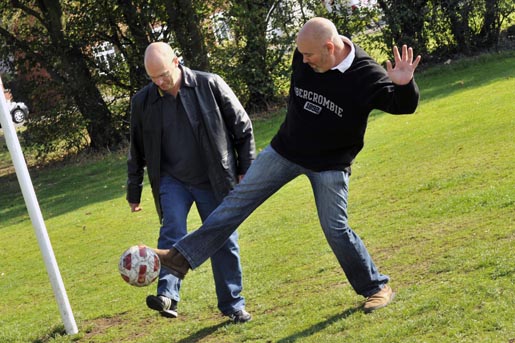
Gary Silke (left) and
Derek Hammond (right),
authors of Got, Not Got
Gary Silke and Derek Hammond are the authors of a recently published book called Got, Not Got, a title that has quickly become an epic tome for lovers of football nostalgia everywhere including ourselves. The book sold in great numbers over the Christmas period (rightly so in our opinion), so we decided to have a chat with Gary and Derek to find out more about Got, Not Got and their love for the bygone days of The Beautiful Game.

TFA: First of all, let’s begin by congratulating you both on the huge success of the book. It’s richly deserved... but how did the project begin?

DH: Thanks a lot! I'm not sure the success is exactly 'huge' but we've had a very promising first few months both in terms of growing sales and press and reader feedback.

We first punted a book to publishers about 7 years ago - centered all around 'Supersonic Soccer Stuff They Sold Us in the Seventies' - and we had a couple of very near misses. About three years ago something much more like GNG was again touted around by a different agent, with the same response. The feedback we were getting all suggested it would be impossible to sell football nostalgia to fans of more than one club.

TFA: And prior to the project starting, when did the two of you first meet?

GS: I'm surprised to say I can't really remember. I think Derek contributed something to my Leicester fanzine The FOX and it was quite funny. He was just a crazy kid looking for a break and hey... I took a chance on him.

TFA: Reading through the book, it’s plain to see how much time and effort has gone into compiling and writing all the entries. You must have reached a point where you realised there would be too many subjects to cram into one book... How frustrating was that for you?

DH: No problem! We realised early on that we couldn't possibly fit it all in, and started to think about GNG2... Now readers are sending us great ideas (fog! DIY ticker tape! Brut! proper drop balls!) and pictures on a weekly basis, and once again it's a case of having to decide what to fit in and what to leave out.

TFA: Despite all that, however, was there anything you forgot to write about or wished you’d included after the book went to press?

GS: I can't really think of anything we wish we'd included. Maybe rolled down socks in the manner of Rodney Marsh and the Argentina side of 1978?

I was also desperately trying to get hold of a Striker diving goalkeeper to do a big close-up photo of but I kept getting pipped at the post on eBay. I SHALL get one for GNG2.

We started the book with the intention of doing 120 pages, but at a very early stage the publisher requested we make it 240. It soon became clear, even then, that a GNG2 would be required.

TFA: Which entries in Got, Not Got did you both particularly enjoy writing about?

DH: Swivel boots, Cov Girl of the Match, Shame, Smoke, Punk Rock Football. I'm easily pleased.  

TFA: We’re pleased and grateful to say you’ve also set up a Got, Not Got blog site to accompany the book. What are you hoping to achieve with the blog and what have been your favourite entries on the site since it began?

GS: Our publicity comes from a very grass roots level so it was important to get a blog going to help spread the word. With Facebook and Twitter added we have started to reach a wider audience. It is also a rallying point for like-minded people to come and discuss all our great old stuff. We want to encourage a wider level of participation for the next book. Everyone has a great story to tell and some old tat to illustrate it.

I like the stuff we are getting sent now because it is fresh to us and makes for a great blog entry.

TFA: Looking forward, you must still have lots of ideas buzzing around in your heads for future blog articles and entire projects, even. Is there anything you have in the pipeline you’re thinking about creating that you can tell us about?

DH: We're working on a humour book for publication later this year. Then there's GNG2 to look forward to, as we both accidentally let slip earlier!

TFA: OK, it’s ‘what if’ time now... If you had to create a football nostalgia Hall of Fame, what would be the first three things you’d put in it? (They can be real items or generic concepts, specific or general...)

GS: Subbuteo seems to hold a very special place in the heart of the nation and I see they are now relaunching it so it will no longer be a 'Not Got'.

Mud, sums up how different football was then. So that would be in. When was the last time you caught the smell of mud at a professional football game?

And just that feeling of quivering excitement you got when you were going to the match as a kid. I think only an FA Cup Final for Leicester City could re-ignite that feeling for me now. And even then I'd probably just end up getting annoyed by something modern.

TFA: And of all the items of football ephemera you actually own, what single things would you both nominate as your favourites, and why?

DH: For ironic bad-taste fun it has to be my Justin Fashanu rubber, cover star of GNG. I just got a very cool fake Action Man for GNG2, for 99p, complete with totally unnerving psychotic glare. No joking, he is genuinely scary.

From a more personal perspective it has to be my childhood box of football cards - which is why I was touched when James Brown at Sabotage Times reviewed the book and said it was just like finding his old football stickers.

TFA: Sticking with your own personal possessions, which items did you both once own that you now regret getting rid of?

GS: My Leicester City Admiral shirt was nicked from the PE changing rooms circa 1979. I'm just about over it, though I still intend to hunt down and execute the bastards who did it.

TFA: Is there anything either of you really wanted to own that you finally managed to purchase, and were you ultimately pleased or disappointed when you got it?

DH: I would give anything to see the original advert for swivel boots which so affected me back in around 1970. To see the actual boots, complete with the patent turn-on-a-sixpence rotating turntable of four studs under the ball of your foot... that would be close to a religious experience for me!

TFA: If you don’t mind us asking, have you ever spent a ridiculous amount of money on a single item of football nostalgia?

GS: I spent a ridiculous amount on two items, but probably not in the way you mean. This woman at a car boot sale had two matchworn 'Ind Coope' City shirts from the mid 80s. I asked her how much she wanted and she said: "10p.... each."

I paid and left. Does that make me as bad as the bastards who nicked my Admiral shirt? It does, doesn't it?

TFA: A lot of people are now becoming disenchanted with modern football for various different reasons. Do either of you fall into this category and what do you find so appealing about bygone football over and above the game as we know it today?

DH: We both fall deep into this category - I guess that much is pretty clear from the book - but of course we keep plodding to the football because we're hooked. The modern game lacks characters, atmosphere, a sense of fun and glorious abandonment, it's overpriced and over-defensive, players and coaches are scared to lose, and there aren't any floodlight pylons or greyhound tracks any more. Apart from that, it's great.

TFA: It’s been suggested to both of us that a better title for your book would have been ‘Got, Got, Need’ as an alternative refrain by sticker-collecting schoolchildren everywhere. Are you willing to admit you named your project in haste and apologise for your wrong-doing?!?!!

GS: In our playground it was always 'got, got, got, not got'. I think there are regional variations. The title works on two levels with everything in the book being something we had 'Got' and have now 'Not Got'. That's the only way it could work.

TFA: The FIFA World Cup in 2010 saw a sudden increase in the number of adults collecting Panini stickers, presumably as a way of reliving the joys of their youth. Do you consider it wrong in any way to collect stickers well beyond your childhood years or do you encourage such behaviour?!

DH: I haven't personally collected football cards since I was a kid, but Gary has. I'm a serious student of football culture and pop history, and my interest in vintage ephemera is for research purposes only. He's just an overgrown child. My collection, meanwhile, just happens to be expanding faster than his... but let me assure you it's for all the right reasons.

TFA: Speaking of Panini stickers, what’s the most stickers you ever swapped (or saw swapped) for just one other? (Rich J once witnessed about 300 swapped for a single Jim Smith which was needed to complete a Panini Football '87 collection...)

GS: I can't remember the figures but I had to hand over an absolute stack for Kevin Beattie to complete my 1973-74 FKS Sticker Album. And it was damaged so I had to do a repair job with a blue biro.

I learnt a lesson that day, keep your cards close to your chest and never advertise how much you need something.

TFA: Finally, what would you say is your personal cut off date, where ‘nostalgia’ ends and ‘modern day’ begins?

DH: 1992. Year Zero.

Gary and Derek, many thanks for your time and all the very best of luck with your future ventures. Keep up the good work with Got, Not Got!

Got, Not Got is published by Pitch Publishing and is available via Amazon.co.uk at the new low price of £11.99.

Wednesday, 8 February 2012

News of the World and Empire News Football Annual 1961-62

Behind the creased and crumbling cover of this 50-year-old pocket book lies not only 384 pages of facts, figures and statistics but a fading image of a football world few of us can fully appreciate.

Things were very different at the start of the 1960’s, including the title of our subject. The News of the World Football Annual (as it came to be known for more than 40 years) started out as the Athletic News Football Supplement and Club Directory in 1887. Little more than a pamphlet back then, it covered more and more content with every passing decade and merged with other similar publications, changing names as it did so. In late summer 1960, the 70th edition of the annual appeared, and for the first time, The News of the World saw its name on the front cover.

Stats, stats and more stats

The purpose of the book remained constant; to cram in enough anecdotal and factual information to sustain the most ardent football fan for an entire season. Beyond the hand-tinted picture of Sheffield Wednesday’s Ron Springett and Don Megson on the cover, there was more than enough to satisfy the enthusiastic youngster or the seasoned veteran, whatever their interests.

Though football had existed for around 100 years at the time of publication, the book showed the sport as only just entering a new era where foundations were being laid for the game we know today. The £20 maximum wage had only just been abolished (allowing players to earn anything up to £100 a week), the England team were preparing for only their fourth World Cup tournament and the great old teams of the 1950’s were slowly making way for the sides keen to make an impact in the 60’s and 70’s.

One-man teams

On this latter point, the NoTW Annual features a piece written by Tom Finney OBE, a legend for Preston and England who had retired in 1960. The Lancashire-born striker lamented his old club’s relegation at the end of the previous season and noted how other big teams of the era had only just avoided a similar fate. “Blackpool only just escaped it” said Finney. “How they will miss the inspiration of Stanley Matthews when the old maestro finally decides to call it a day. Without the skill and drive of Nat Lofthouse, Bolton Wanderers just steered clear of the danger zone. And how would Fulham have fared without the genius of Johnny Haynes?”

Tom Finney wondered whether the great teams of the day were too reliant on a single star-name player to get success. If they were, the removal of the £20-per-week wage limit in January 1961 was designed to keep more of them in the British game. Prior to the pioneering work of Jimmy Hill, chairman of the PFA, many Italian clubs were offering vastly better pay for any professional willing to up sticks for the continent. The Annual reported how Jimmy Greaves had joined Milan in June 1961 for guaranteed earnings of £40,000 over three years plus a £10,000 signing on fee. Aston Villa’s Gerry Hitchens went to Inter in the same month for £25,000 over three years, while Charlton’s Eddie Firmani made Inter his second Italian club in June 1958 having already spent two years at Sampdoria. Just before the book was published, Denis Law left Manchester City for Torino for a British record fee of £100,000.

Costs increase, squads shrink

Such a slow bleed of England’s top talent to the continent was of great concern – not least because attendances were falling and clubs were operating at a loss. Ivan Sharpe wrote how “the day of the club with a staff of 50 or more professionals seems to be over” and lamented that the ability of teams to nurture young talent could be severely threatened. Sharpe also commented that 17 of the 44 First and Second Division clubs were financially in the red, thereby causing a pall of doom to hang over the game in England.

It wasn’t all depressing news, however. Malcolm Gunn was quick to highlight the positive change in fortunes for East Anglian clubs at the time. Ipswich Town had returned to the top flight as Division Two champions under the promising leadership of Alf Ramsey. The total cost of the team? Just £30,000 – around the same price paid for a typical top flight player.

Gunn also highlighted the great achievements of Peterborough United – champions of Division Four in their first ever league campaign of '60-'61and newly-crowned record holders for scoring 134 goals in their 46 games. As for Norwich City, they too were on the up-and-up; 1961-62 would be the season in which they won the Football League Cup in only its second outing

Spurs at the Double

Elsewhere, the buzz was all about Tottenham, recent double winners proudly lead by captain Danny Blanchflower. As well as reflecting on the rare achievement of winning both major competitions in English football, Blanchflower also took the opportunity to write about the growing demand for substitutions to be allowed in the FA Cup Final. The future Northern Ireland manager went one step further by calling for subs to be allowed in every Cup round. “Supposing Leicester City had got to Wembley by knocking out a team that had been reduced to ten men [through injury]. How would they have felt if, in the Final, they were allowed what their earlier opponents were denied?” said Blanchflower.

Yes, things were certainly different back then and a glance through the five-page 'Football Diary' of the previous season illustrates this perfectly.

On October 26th 1960, Charlton and Middlesbrough drew 6-6, equalling the record for the most goals in a drawn Division Two match. 'T.Docherty', an Arsenal and Scotland international became coach at Chelsea on February 10th 1961 - ten full years before taking the reins of the Scottish national team. March 17th 1961 saw the appointment of Don Revie as manager at Leeds United and within three years had got the side promoted to Division One. Finally, on June 26th 1960, the great Arsenal, Sunderland and England centre forward Charles Buchan passed away. At the end of his football career, he turned his hand to journalism and eventually gave his name to the world's first football magazine, 'Football Monthly'.


And as if all that wasn't enough, the Annual also had plenty of froth and nonsense to break up the formality of endless words and statistics. Adverts for 'Gent's Drip-Dry Shortie Raincoats', appliances to increase your height and gold-plated lucky charms were littered throughout the publication along with a welter of ads for bookmakers and pools companies alike. Some 50 years before British TV screens were treated to the sight of Ray Winstone's revolving head for Bet365, it's fair to say the public were tempted into the tantalising world of gambling in an altogether more serene way.

Sunday, 5 February 2012

England v USSR (Match-Day Programme, 1984)

We're delighted to bring you our very first guest post courtesy of Rob Langham, a member of the team behind the brilliant blogsite The Two Unfortunates. Here, Rob takes us back 28 years to an international game he attended at Wembley and the match-day programme that accompanied it...

The programme for England’s international against the USSR, a match that took place on 2 June 1984, is a fascinating time capsule, not least due to the advertising strategies of the time - more of which later.

Unbeknownst to all of us at the time, the Soviet Union only had another seven years to run. Mikhail Gorbachev was still a year away from assuming office and our relationship with the USSR was filtered through the prism of the late Cold War period - tit for tat Olympic boycotts and Frankie Goes to Hollywood’s video for Two Tribes perhaps the most memorable manifestations of international relations.

That was a polyglot Soviet side. Having performed solidly at the 1982 World Cup in Spain, they, like England, had failed to reach that Summer’s European Championships in France. Far from Russian-dominated, the various republics of the union were well represented with captain Aleksandr Chivadze and Tengiz Sulakvelidze representing Georgia, Sergei Aleinikov and Sergei Stukachov hailing from Belarus and Kazakhstan respectively, and the Armenian Khoren Oganesyan acting as the XI’s primary creative force.

All of that was to be swept away two years later of course - as incoming manager Valeriy Lobanovskiy made a better fist of what Ron Greenwood had tried to do with Liverpool players for England the previous decade by jettisoning much of the existing squad (including Oganesyan - dropped for developing a ‘star complex’) and packing the team with the Ukrainians of Dynamo Kyiv.

But for now, it was an effective and unspectacular unit that cantered to a 2-0 victory against an England led by Bobby Robson.

In his programme notes, Robson opined about the lack of availability of players on a consistent basis and it was a weakened team that eventually took the field here - Mike Duxbury’s horrendous error allowing for the first goal and provoking a chorus of boos in a sparsely populated Wembley.

The old guard - Peter Shilton, Terry Butcher, Bryan Robson, Ray Wilkins and Trevor Francis was supplemented by a number of newcomers with perhaps the most significant being Gary Lineker - appearing in the squad for the first time in the 1-0 defeat to Wales that Spring.

But the number of unlikely names betrays a team in transition after the failure to overcome Denmark in European Championship qualifying. Former NASL man Steve Hunt, David Armstrong, Mike Hazard and John Gregory all made it to Bisham Abbey.

The most intriguing of the inclusions was winger Mark Chamberlain, Dad of Alex Oxlade-Chamberlain and a man who performed spiritedly on the afternoon - overshadowing the man on the opposite flank, John Barnes (the latter was to have the last laugh a few days later when he scored after a mazy run against Brazil).


There was also a Watford inflection to things - as reigning European under-21 Champions, Robson had seen fit to promote a number of that set up to the full team and Nigel Callaghan was one to benefit. Add to that Luther Blissett, at the time a Milan player but forged at Vicarage Road nonetheless.

But the theme didn’t end there. In a year that saw the Hertfordshire club reach an FA Cup Final, the programme advertised ‘The Summer of 84 Concert’ for later that month, with chairman Elton John headlining, supported by Nik Kershaw, Paul Young, Kool & The Gang and Wang Chung plus DJ appearances from Steve Wright and Simon Bates among others. Dull and dreary England’s 2-0 defeat may have been but presumably considerably less horrific than the entertainment offered by that shower.

Elsewhere in the publicity sections, the prospect of gridiron action involving the Tampa Bay Bandits and Philadelphia Stars was offered (no, I haven’t heard of them either) and a typically oblique Benson and Hedges adorned the back page - MIDDLE TAR.

Our thanks go to Rob for that wonderful trip down memory lane, and don't forget you can catch more of Rob's writing (together with that of many other fine folk) at www.thetwounfortunates.com. We also urge you to follow TheTwoUnfortunates on Twitter, too.

If you'd like to contribute an article of your own, please do so - simply contact @COakleyFtbl or @sofa_soccer on Twitter or leave us a comment on one of our blog posts and let us know all the details. Cheers!

Friday, 27 January 2012

Hero - The Official Film of the 1986 FIFA World Cup

Mexico 86! Again?  Sorry... I don’t just cut 'n' paste these articles you know, but given my football nostalgia begins at this juncture, it’s no real surprise it’s a common reference point.

Anyway, there was a World Cup held in Mexico in 1986 and, as with all World Cups since 1966, FIFA produced an official film. You could tell it was an official FIFA product as it was supplied in a brown envelope and cost £300K in used notes plus a vote in some bidding process. Ha! Satire!  Hello, is this thing on? Sorry... again...

And so to the film, and we begin with footage of Maradona (the Hero you see) gliding through the England defence on his way to score what became the 'Goal of the Century' accompanied by what some may call a cod-Aztec synth riff, closely followed by the mandatory-for-the-mid-80s, syn-drums. This was 1986. Rick Wakeman was providing the soundtrack. Prog rock may have been dead, but keyboards were very much alive. "Worldmark Soccer International Presents" a "Challis / Maylan Production"- "Hero - The Official Film of XIII World Cup..."

The film itself begins by covering the devastating earthquake that so nearly cost the country host status only eight months prior to the tournament’s opening match. To this day it remains a great credit to Mexico recovering in such a short space of time. Contrast that with the current situation in Brazil, who’ve so far struggled just to build the infrastructure needed, let alone rebuild any of it. Stirring music plays as the story is told, then as kids play soccer in the streets, contrasted with footgage of "local boy" Hugo Sanchez in Mexico's first match of the finals, the keyboards are back with a vengeance. A much longed for Sanchez goal brings understandably jubilant scenes in Mexico's still ravaged streets.
(NB I'd embed the YouTube video, but Blogger can't find it...it can find Part 2 though!)

After that it's headlong into the bit we all came for; the football, narrated here by Michael Caine doing his best Michael Caine from The Italian Job impression. Greats like Francescoli and Laudrup are showcased in Denmark's mauling of Uruguay, then we link nicely to Denmark's own downfall at the hands of Spain. It’s at this point that the fact this is a ‘film’ as opposed to a record of the event comes to the fore, as a narrative, a story arc, must be forged. To this end, instead of following the tournament in a vaguely chronological fashion, the film details the various routes taken by the more notable teams.

While this approach may provide some dramatic tension, albeit tension somewhat deflated by the keyboard tinklings of Mr. Wakeman, it does leave one with a rather disjointed view of the whole affair.  It also suffers from arc-crash, which is a term I’ve just made up. What I mean is, they follow a certain team down their route to the final, e.g. Argentina. However, Argentina play England in the quarter final, so then we have to jump back to the first round to cover England’s progress to said match.

This method of storytelling, while effective, means that Maradona (the Hero, remember) doesn't feature 'til nearly 20 minutes in and England some while later. As I say, it makes a change from the usual method, but it does often leave you wondering which round you’re watching... and why. Then again, if you want more comprehensive coverage of every goal scored, you may want to track down a copy of ‘Every Goal of Mexico 86’ - though having watched it, I’d advise against it, graced as it is by Martin Tyler in full on ‘reading from the script auto-pilot monotone’ mode and poor man's synth track played through a pillow.

As well as the storyline flying all over the place, the soundtrack also takes a similar flight path, though appears to crash into several objects on its way, such is the jarring nature of it at times. This happens in the form of teams having their own little signature tune, meaning every time, say, France appear, we are treated to a shot of the crowd chanting about their beloved 'Bleus.' This chant isn’t seamlessly blended into the soundtrack however - rather it smashes into it at high speed, meaning the classic quarter final and nerve-shredding penalty shoot-out between France and Brazil is played out to a soundscape that bolts together Mexican Cheese Synth, Cockney narration, “VIVA, VIVA, VIVA LES BLEUS! VIVA!!!” and “Loooooo, lo looooo, lo loooooo, lo lo BRAZIL!”

In spite of these issues, the football itself is served up very well with lots of quality footage, plenty of time given to the stand out teams and matches and goals and replays given the right balance between ‘Ooh let’s see that again’ and the more modern phenomenon of ‘What did that goal look like from the POV of a passing crow?’

To summarise, yes it has its idiosyncrasies and has a distinctly cheesy feeling, but Hero is still a very entertaining watch and does manage to tell the story of Mexico 86 well. The FIFA films do seem to capture the nature of the tournament, with Hero being all bright colours and hard, midday shadows, contrasting nicely with the Official Film of the 1990 World Cup - Soccer Shootout - a much more sombre affair.

Thursday, 26 January 2012

Soccerboss / Goal! / Wembley ad, 1969


We wonder what the 'scientific approach' was that was used in 'Goal'? Anyone got any thoughts?

Tuesday, 17 January 2012

Subbuteo World (Catalogue I), 1979

For just ten of your British pennies, this catalogue could have been yours in the late 1970's, a small price to pay for the unfettered joy that lay within. Twenty-four half-size pages filled with every possible football team, accessory and Subbuteo set was displayed in full colour and capable of generating so much excitement in the juvenile mind that there barely seemed any point in buying the stuff at all.

I say that because this was a doorway into the realms of fantasy that any young football fan would have genuinely relished. Inside we get The Subbuteo Story, a history of the table soccer game in three paragraphs that reminded the reader how this simple pastime had grown and grown over more than three decades.

There was How to play Subbuteo, a worthwhile précis for the newcomer that basically says 'flick the players to move the ball to score goals.' Well you never know – this could have been read by a girl, conceivably.

We see six different Subbuteo Soccer sets available to purchase, each with a differing array of components and each aimed at a variety of budgets. Whether you wanted a basic Display Edition (teams, balls, goals but no pitch) or the full Stadium Edition (containing teams, a pitch, balls, floodlights, ball boys, a scoreboard and a section of grandstand), you couldn't help but let your mind boggle at the choice on offer.

But all of that was nothing compared to the main feature of this catalogue and many others (to say nothing of wallcharts) – the six pages featuring 322 Subbuteo teams in all their myriad colours and patterns. How many hours must have been lost by the thousands of kids gazing in wonderment at the regimented rows of vivid and bright figures before them. Some were familiar, others less so but they were never unfamiliar for long. A quick check of the 6-page index would quickly tell you that the team wearing red and white quartered shirts with red socks and shorts was actually the Italian club Rimini - a team you were never likely to buy but you wouldn't have left out of the catalogue for all the world.

At the back, there were pictures of all the things you could buy to personalise your Subbuteo collection beyond comprehension. Tournament goals, 'live action' goalkeepers (spring-loaded, of course), TV camera crews – hell, even the World Cup itself if you were prepared to squint a bit. And if football wasn't your thing, why not pay the 10p anyway and check out the Subbuteo Rugby and Cricket sets. The enormous cricket-bat-on-a-stick and the oversized ball seemed a little bit odd, but then, like rugby, cricket was for strange people anyway.

And that was that, except for one final note: this was the first of two near-identical Subbuteo catalogues produced in 1979. The other was released later in the year and was different in only one small detail – it had the Iran national football team in its listings. Never let it be said that Subbuteo didn't cater for all tastes.

Sunday, 15 January 2012

The Big Match: Manchester United (DVD)

For those of you who aren’t in the know, The Big Match is a wonderful range of DVDs containing footage from ITV’s football archives. The DVDs, made by ILC Media, typically focus on an individual club and a selection of TV games they appeared in from the late-1960’s through to the early-1980’s.

From the nostalgist’s point of view, this set provides everything you could possibly want: bags of brilliant football action, all the original titles and signature tunes, plus the inimitable Brian Moore introducing each of the games. Each disc also comes complete with a bonus set of items culled from the records featuring Moore, Jimmy Hill and Jim Rosenthal discussing tactics, interviewing players and reading viewer’s letters. There’s also a generous helping of the sort of humorous clips that gave the show a friendlier, more relaxed feel than its BBC rival, Match of the Day.

Putting those bonus features aside, let's first take a look at The Big Match: Manchester United, released back in 2009. There are 14 match highlights to watch (see details below), starting with a 2-1 win for United over Arsenal that's notable for being Peter Marinello's debut for The Gunners.

The Next George Best?

As the fresh-faced Brian Moore told us after the game, Marinello was once nicknamed 'the next George Best' although the player was at pains to tell people he was 'the first Peter Marinello.' Given the celebrity spotlight and heavy drinking he endured during his time in London, it's probably fair to say Marinello was ultimately wider of the mark than those people that judged him.

The next match, from the tail end of the 1970-71 season, was United's trip to Crystal Palace which seemed to generate just as much excitement off the pitch as on it. To begin, Brian Moore told us that the Greek national side were in the UK to play England in a friendly and had opted to watch this match at Selhurst Park rather than see Arsenal or West Ham. Their decision, we're told, was made squarely on the basis of wanting to see George Best in action – a shrewdness of judgement borne out by Best's brace in a 5-3 win.

Shooting practice at Palace

After the match, Moore told us that 'he always thought Palace were a fair minded club but they were disappointed to lose a match they thought they'd win.' Was the famous commentator being brutal in his assessment of the South London club?  Not a bit of it. Unbeknown to us, Moore was just teeing up a short, humorous clip edited together by the boys in VT.

Cut to a number of tanks trundling around the perimeter of the Selhurst Park pitch firing at randomly chosen United players that were seen writhing on the ground in agony.

We can only presume there had been some sort of military hardware demonstration on the day of the game and The Big Match, being what it was, couldn't pass up an opportunity to make it look like Palace had sent the tanks out to blast away at the United players. Weird, but pleasing in a 'couldn't-happen-in-this-day-and-age' sort of way.

A gradual slide

The first few highlights packages we see on the DVD show Man United as a team in transition at the start of the 70's. Although the big names such as Best, Law and Charlton were still around, so too were a number of lesser-known players long since consigned to the history books. By the time the 1974-75 season rolled around, United were only a shadow of the side that had won the European Cup six years earlier and they now found themselves in Division Two.

A new order emerged for United, destined as they were to make an immediate return to Division One under Tommy Docherty. We get to see his transitional side in an exciting 4-4 draw at Hillsborough during which Lou Macari (2), Ron Davies and Stewart Houston all got on the scoresheet, but these were worrying times on the terraces.

The hooligan element

When Bernard Shaw scored to put Sheffield Wednesday 3-1 up, many Manchester United fans ran onto the pitch. Commentator Keith Macklin concluded that this was another attempt to deliberately get a game postponed as had happened in a previous Man United match against Newcastle United. On this occasion at least, the rowdy fans were cleared and the game was allowed to continue.

The next clip showed a resurgent United brushing aside Birmingham City in January 1976, but it was the frosty post-match interview that caught the eye on this occasion. Birmingham's Archie Stiles had been sent off for aggressive behaviour towards Alex Forsyth and this prompted Tommy Docherty to tell Gerald Sinstadt that this was a growing trend in the modern game. He even went so far as to suggest that the media weren't highlighting the problem enough and told the commentator that TV companies were editing out most of the violent incidents to give a false impression of how things really were.

A big miss

In general terms, Brian Moore was only ever absent from his comfy studio chair once a year, and that was for the Christmas edition of The Big Match. On those occasions, the presenting duties were handed over to a well-known player of the day or, as was the case in 1976, Elton John. In January 1978, however, presenting duties were handed over to Dickie Davies (presumably because Moore was ill) and we get to see the World of Sport presenter being his usual professional self on the DVD as he introduces a match between Derby and Man United.

The clip from the 1979-80 season is something of a collector's item in that it shows Kenny Dalglish providing arguably the miss of the century at Old Trafford. With the score at 1-1, Liverpool were on the attack and Alan Hansen had the ball at his feet. Seeing the United defence push up in a regimented fashion, the future Match of the Day presenter played the ball over the top and ran onto it, thereby beating the offside trap. Hansen was left with only the United keeper to beat but he unselfishly passed to his team mate, Dalglish.

In so doing, Dalglish was flagged offside, but the Scottish international striker was unaware of this and duly shot into an empty net… but missed. Manchester United went on to win the match 2-1 yet for Liverpool it was difficult to know who was more at fault – Hansen for passing to his offside teammate or Dalglish for being so poor with his shooting.


Captain Marvel arrives

The rest of the highlights footage sees United slowly emerging from Liverpool's shadow, beginning with Bryan Robson signing for United on the Old Trafford pitch before their match against Wolves in October 1981. The DVD ends with a rousing 4-0 win for the Red Devils at home to Notts County in which Robson, Norman Whiteside, Frank Stapleton and Mike Duxbury all make their mark.

United's journey from the days of Best and Charlton through a traumatic relegation and back to being a big hitter in Division One again is chronicled wonderfully well here and like all the other DVDs in the collection, it gives a great overview of a fascinating period in football history. We'll be looking at more DVDs from The Big Match collection on The Football Attic in the not-too-distant future.

The Big Match: Manchester United is available from Amazon.co.uk and all other reputable DVD outlets.

Games featured:
1969-70: Man United 2-1 Arsenal ; 1970-71: Crystal Palace 3-5 Man United; 1971-72: Coventry 2-3 Man United; 1972-73: Man United 3-0 Derby; 1973-74: Man United 2-2 Chelsea; 1974-75: Sheffield Wednesday 4-4 Man United; 1975-76: Man United 3-1 Birmingham; 1976-77: Man United 3-1 Man City; 1977-78: Ipswich 1-2  Man United; 1978-79: Derby 1-3 Man United; 1979-80: Man United 2-1 Liverpool; 1980-81: Nottm Forest 1-2 Man United; 1981-82: Man United 5-0 Wolves; 1982-83: Man United 4-0 Notts County.

Thursday, 5 January 2012

Top Trumps: British Soccer Stars (1978/79)

Whenever anyone does a survey of the best children’s toys and games of all time, it’s always the same names that get mentioned – Monopoly, Trivial Pursuit, Castrate The Racist… well maybe not the last one, but you get the picture. No-one, however, stops to consider Top Trumps – surely the only card game that ever really attained ‘legend’ status among school children up and down the UK.

Before we get onto the specifics of the British Soccer Stars pack, it’s only right to consider what Top Trumps is all about and why it’s still held in such high regard to this day. Top Trumps is a brilliantly simple game for two or more people where each player is dealt an equal number of cards from a pack. The object of the game is to win all the cards from your opponents, and to do this players take turns to read out a statistic from their card in the hope that it’s ‘stronger’ than the equivalent one on their opponents’ cards. If it is, they win the cards for that round.

From the late 1970’s many packs started appearing in the shops and all of them were cheap enough for kids to buy with their meagre pocket money. All manner of subjects were covered from Dragsters to Military Aircraft but it was the football packs that allowed the average schoolboy (or girl) to indulge in their hunger for knowledge.

And so it was that the first of those football packs, Dubrecq’s British Soccer Stars, arrived on the scene in 1978 to brighten up the dullest of school breaktimes. The set contained 32 cards featuring the great and the not-so-great of English league football, classified across the five categories of International Appearances, International Goals, League Appearances, League Goals and Height.

It’s at this point one has to stop and wonder what the modern-day sets of football Top Trumps must be like in this era of Opta Stats and the media’s clinical dependency on significant data of any kind. To be honest, we’ve not looked at the current sets because they don’t enter our realm of nostalgia, but we wouldn’t mind betting that they probably have categories like ‘Kilometres run’ and ‘Passes completed.’ Such is the price to pay for progress, we suppose.

On the subject of height, you’d be more than happy if you were dealt a goalkeeper or two during a game, although in this set it was no guarantee of success. At 5’ 11½” Liverpool’s Ray Clemence seemed a dead cert to win you a hand, but you’d have overlooked Phil Thompson, Glen Hoddle (sic) or Paul Mariner at your peril. They were a full 6-feet tall, as was the other goalkeeper in the pack, Peter Shilton. Champion Top Trumpers take note.

The thing is, goalies were a complete liability in Top Trumps if it wasn’t your turn to call a category. If the lead player shouted out ‘International goals’ or ‘League goals’, you were instantly onto a hiding and by 1978 neither Shilton or Clemence had racked up that many International Appearances either.

In fact 1978 provided an interesting snapshot of the 'Old Guard' in the prime of their careers and a new wave of players starting to emerge. When it came to International Appearances, one of the worst cards to own was that of the aforementioned Glenn Hoddle. Still in his early-20’s, he didn’t make his England debut until 1979, so you could be sure one of your opponents would get the dubious honour of owning that card. Emlyn Hughes, on the other hand, reached the peak of his international career around the time this pack came out and was the best in that category with 49.

Hughes was also a big hitter in the League Appearances category along with Manchester United’s Martin Buchan. Once again however, Glenn Hoddle was the player to avoid with only 62 appearances to boast, compared to Buchan and Hughes who had more than four times that amount.

But such talk of statistical one-upmanship only accounted for part of the game’s appeal. Aside from all the facts and figures was the visual charm which, being the late-1970’s, could be summed up in one word: 'rudimentary'.

Yes, each card had a colour picture of each of the players and yes, each one had a circular inset showing a close-up of the player’s face, but it has to be said that the photography did at best leave a little to be desired. The wide shot of Ray Clemence, for example, is unflattering in its portrayal of the England goalkeeper’s obscured face in the main picture. Phil Thompson’s face can barely be seen at all (something he’s more than made up for by becoming a regular on Sky’s Soccer Saturday) while Mick Mills looks like the only player practicing keepy uppies at his local training pitch. As for those circular insets, we can only assume Ray Kennedy wasn’t given the stool to stand on that he’d asked for.

To be honest, we’re also at a bit of a loss to understand why some players had even been selected for this collection. Fine – pick Stanley Bowles, Ray ‘Butch’ Wilkins and Andy Gray if you must, but Peter Ward of Brighton? Clive Woods of Ipswich? Are these the actions of a true football fan or an agent keen to see get his client some much needed exposure?

We’ll probably never know and that’s no doubt for the best. We wouldn’t have asked such questions when we were nine years old and we shouldn’t ask them now. This was the game that captured the imagination of millions of young football fans and in updated form continues to do so today. Quirky and lo-tech, you can’t help but love it and long may it continue.

Tuesday, 3 January 2012

Shoot! 28 October 1978

The qualifying competition for the 1980 European Championships had just begun when this issue hit the shops. Shoot! covered the upcoming round of fixtures involving the home countries and devoted much of its content to it accordingly.

England v Republic of Ireland

Having already won 4-3 in Denmark, England were about to make their first trip to Dublin for 14 years. Ron Greenwood's men hadn't reached the finals of a major competition since 1970 and this appeared to be their best chance of doing so given the talent available.

The former West Ham boss had put the emphasis on attack against the Danes, a tactic that suited players like Kevin Keegan, Trevor Francis and Tony Woodcock, but the Ireland squad was widely regarded as the best one ever and were seen as worthy opponents. Player-manager Johnny Giles was able to choose from a wealth of new and established Football League stars such as Liam Brady, Steve Heighway and David O'Leary, yet England 'keeper Ray Clemence didn't see them as much of a threat when he wrote about them in his weekly column.

Clemence was quick to focus on Johnny Giles' playing role specifically. The former Leeds United star was 37 years old going into this match and the Liverpool number 1 noted how some Irish fans were asking Giles to step aside to allow someone younger to take his place. As it is, the Republic of Ireland stalwart brought much experience and a steadying influence to the squad and this bore fruit as Ireland went on to draw 1-1 with England in Dublin.

Scotland v Norway

Scotland, meanwhile, were adjusting to life under new manager Jock Stein. Following a disastrous World Cup campaign only a few months earlier, Ally McLeod had miraculously been given a vote of confidence by the Scottish FA and was allowed to start the Euro '80 qualifying competition. When his side then lost their first match 3-2 away to Austria, however, McLeod was relieved of his duties, allowing Stein to take his place.

Jock Stein was already perceived as something of a legend having guided Celtic to European Cup glory in 1967 – the first time a British club had won the competition – yet his reputation was called into question by writer Chris Davies.

Only 45 days earlier, Stein had taken on the manager's job at Leeds United but surprised the football world by performing a dramatic U-turn to lead the Scottish national team instead. Davies noted how Stein had often preached loyalty to his players in the past yet had now turned his back on the Elland Road club. Stein claimed his wife hadn't taken to their new life in Leeds, but this only prompted Davies to wonder how she could have developed such a dislike of the place in such a short space of time.

Stein had also said he felt unable to turn down the Scotland job on account of being so patriotic, yet he'd declined such an offer while acting as caretaker manager in 1965. All this was casting Stein in a less than favourable light, Davies concluded, to say nothing of the precarious nature Leeds were left in with no manager.

Stein went on to lead Scotland to a 3-2 win over Norway that week, but ultimately failed to maintain their form during the entire European qualifying campaign. Scotland finished next to bottom in their qualifying group below Belgium, Portugal and Austria when the competition ended 17 months later.

Tough times at Stamford Bridge

Domestically, the spotlight fell on Chelsea in more ways than one. Lumbering through a financial crisis, they'd seen gate receipts plummet after a couple of seasons spent in Division Two. Despite returning to the top flight in the 1977-78 season, their position looked vulnerable and an air of uncertainty had enveloped the club.

This was reflected in Ray Wilkins' regular column where he confided his inability to pinpoint the reasons behind Chelsea's poor run of form at the time. Though they were playing capably enough on their travels, Chelsea's performances at home were particularly poor. "We use the same formation but the ball is like a hot potato… no-one wants it" Wilkins remarked. The players were undoubtedly lacking in confidence and there was a need to be more professional, he went on to say.

A welcome distraction (to say nothing of a financial fillip) came in the form of a friendly match against New York Cosmos at Stamford Bridge a month earlier. The NASL outfit were on a European tour and had stopped off in West London to help The Blues generate some much-needed revenue.

A crowd of 40,000 turned up to see the match in which Johan Cruyff primarily caught the eye. Cruyff was invited to take part in the tour and was thought to be joining the New York club on a permanent basis having left Barcelona in the summer of 1978. Chelsea had also mounted a 'dramatic bid' for him according to Shoot! but his next move would be to Los Angeles Aztecs the following year. Meantime, Cruyff's show of skill and flair in the exhibition match against Chelsea earned him a place at the start of the opening title sequence of ITV's The Big Match as you can see here.

News Desk

In other news, Tottenham's Gerry Armstrong was expressing his dissatisfaction at the varying number of roles he found himself undertaking for the North London club. 'Play me up front - or let me go' ran the headline as the article reminded readers of Armstrong's many recent substitute appearances. Shoot! reported that Birmingham, Arsenal, Ipswich, Aston Villa, Luton and Fulham were all interested in the Northern Ireland international, but in fact he stayed at White Hart Lane until a move to Watford nearly two years later.

Manchester United, meanwhile, had posted a loss for the previous season of £290,349. This had been largely down to Dave Sexton splashing out £1 million on Leeds United pair Gordon McQueen and Joe Jordan, so we were led to believe, but United fans could sleep easy in their beds. The Manchester club had made sufficient enough profits over the previous three years to leave them with an overall profit of £624,468 – "just enough to buy Trevor Francis, if he should become available when he recovers from injury."

Regular features and colour pics

Finally, this issue of Shoot! contained many of its most well-known features including You Are The Ref ('Compiled by Clive Thomas'), Ask The Expert (a chance for readers to pit ridiculously dull trivia questions to the magazine's researchers in the hope of winning £1 for having their letter published) and Football Funnies (five cartoons that regularly challenged the Trades Descriptions Act and all selected by an invited football player of the day, in this case Manchester City's Peter Barnes).

Yet as everyone surely knows, Shoot! could always be relied upon to provide its readers with a liberal sprinkling of glossy colour photographs, and this edition was no exception. The middle pages contained part of a week-by-week pull-out booklet featuring top players from the home countries, this one including profiles of Scotland's Willie Donachie and Northern Ireland's Pat Rice. There was also a double-page spread showing snapshots from the last round of Euro '80 qualifying matches, but the back page was reserved for the obligatory team picture which this week took Stoke City as its subject.

The Potters were riding high in the Second Division at the time and would go on to gain promotion to the First Division at the end of the season, doing so with the barely believable combination of Garth Crooks and Howard Kendall among its roster list.